Showing posts with label photography. Show all posts

August 25, 2015

a walk in the woods, macro-style

Small details of a late July afternoon walk in the Wisconsin woods, captured courtesy of my macro lens. Looking down (and up) at the small details gives you a different view of things. 

Click on any picture to see the photo larger.

wild raspberry (macro lens)

leaf patterns

golden light
(I did alter the coloring a bit in this photo)


lichens and moss (macro lens)

Lichens #1 (macro lens)
--reminds me of something out of a Dr. Seuss book

Lichens #2 (macro lens)

lichens and tree bark (macro lens)

forest renewal...

thistle (macro lens)


unknown forest plant (macro lens)


late afternoon sun

I hope you enjoyed my trip through the woods! 

August 12, 2015

the golden hour: light and shadow (and spots)

a couple weeks ago we were back in WI and IL to visit our families. One day, I drove from the WI Dells area to spend the afternoon with my sister. Driving back from my sister's house to the Dells late in the afternoon cross-country, I drove around a corner and came upon this beauty... I grabbed my camera and opened the passenger side window to snap a couple quick shots. (As always, click on any of them to make them larger!)

on the edge of sunlight and shadow--


zoomed in-- turns out it's one of this year's fawns
(fyi, according to the internet, fawns have an average of 300 spots)


gone! (two white tails-- can you see both of them?)


zoomed in-- they run in leaps and bounds!! 
It's too bad this time of day lasts for such a very short period of time... from looking at these pictures, it's clear to see why photographers call it the 'the golden hour' for the golden quality of the light it brings to the scene.

March 23, 2015

desert spring wildflowers- get read to scroll!! (photo heavy!!)

a couple of weeks ago, I got up insanely early on a Saturday (insanely early for me on a weekend, anyway-- before the sun rose) and headed south to Picacho Peak State Park, about 1 1/2 hours south, on the way to Tucson. I wouldn't ordinarily do such a thing but I had heard reports on the news that the spring wildflower bloom was the best it had been in the past 10 years due to the rain and winter temps we've been having. So, I figured I could sleep later!! 

We'd been to this state park once before, in 2007, I think (?) to hike to the top, but this time, I was going to meander around, look at wildflowers, and hopefully get some good photos. I took over 700 in the time I was there; you'll have to tell me what you think of them!

(and by the way, as always, click on any of the photos to make them larger- and hopefully even more impressive!)

  Enjoy!!

7:30 am, the sun just hitting the north edge--
this is looking towards the "Sunset Vista Trail Head" I believe. 

looking south, towards the peak. The left-most tip is actually where the longest trail goes to.
(Hunter Trail: steep and twisting, difficult rating.)
You should have gloves, because you need to pull yourself up via steel cables in a few places.
(I didn't make it all the way to the top when we hiked it, but Tom did.)

Saguaro & 'nurse tree' ocotillo. Saguaros grow sheltered underneath or around another plant
or tree till they get big enough to handle the wind, sun, etc.  Eventually they will
outgrow the nurse tree, or even outlive them, in the case of a mesquite or Palo Verde.

I didn't see too many birds (I heard a few), except for a couple hummers--
they were quick, but I did snag a few (poor) photos. Not sure what kind
this guy is; the sun is on the wrong side of him to get a good look.

Saguaro forest in the morning sun-- isn't it magnificent?? (9:00 am)

desert lupine, close-up.

Saguaros in a field of California poppies and desert lupines

Desert globemallow, pink variety (I think). Usually these are orange-r than this,
but I think it's the same species. The flowers are small, about as big as a 50-cent piece.
Reminds me of hollyhocks. You can see these (bushy) plants along the highway, too.

Not a flower, but flower buds on some sort of cholla cactus.

too bad I was too early to see the flowers-- this cholla is just loaded with flower buds.

a scenic vista, looking southeast.
(actually, this state park is right off the interstate, so you can actually see traffic on I-10
from the park. The horizontal line in the background is the interstate.)

I really like this one.
At the left, you can see just a bit of a Saguaro
skeleton sticking up out of the brush.

gorgeous views-- my photo composition skills couldn't do them justice.

yup, it's what you think it is- a snail shell. In the desert.
I was off the marked trail a bit, heading down a dry wash that had
obviously held water at one time or another. (thankfully, there
was NO rain anywhere in the forecast that day.)

Standing in that wash, looking uphill... another Saguaro skeleton.

again, I couldn't do the scenery justice, but I quite like this one--
it says something to me about the 'renewal' of nature, with the ephemeral
wildflowers alongside the hundreds-of-years-old Saguaro skeleton.
(sappy?? maybe. probably.)

another view of the hillside.

I found GOLD!! (haha!! I couldn't resist.) isn't it gorgeous??

These poppies are delicate looking!!
(I'm sure they're tougher than they look,
though, to make it in the desert.)
It was a bit breezy, so they didn't want to stand still.

So, the marked hike I went on (then went off of) to take all these pictures was only miles long, lol!! It took me, oh, maybe, 4 hours to piddle around in, on, and around that trail, and I took 245 photos in that time. (of course, quite a few of them aren't worth anything, photographically speaking)

All this is to say, I have quite a few more photos to post yet, so check back again soon. I've printed quite a number, too, so I can make a few (okay, quite a few, lol!) scrapbook pages.

thanks for accompanying me on my wildflower walk!

January 18, 2015

our prospective new neighbors are a hoot!! (lol!!)

So in the past few weeks we've heard some new, rather noisy neighbors around our house. They're not around very much; it seems like they're most active in the late afternoon / early evening time-frame, but I've also heard them a number of times very early in the morning-- when it's still dark out, even. I haven't complained about them, though, because really, they're more fascinating than annoying- at least to me, anyway. They sit in the oddest places, too-- we've seen them on the roof of our house, even! I have taken some photos of them, too, when I've been able to catch them in the act-- they stared, but didn't seem to mind it too much.

About now, you're probably wondering why I would do such a thing, think I'm extremely rude, and that we have really strange neighbors, right?? 

Well, you can judge for yourself... here they are:  


hahaha!! Did I have you going at all?? (probably not; I'm no good at jokes or telling stories...) It's a pair of great horned owls!! We started hearing them about a month and a half ago, just once in a while, but couldn't see them. Then, for a few days, they were around every afternoon just as it was getting dark. They would pick a vantage point on the peak or corner of one of the roofs, including ours, and do their hooting back and forth.


At first we only saw the one-- Tom saw it more often than I did, because he usually gets home from work earlier than I do, but I managed to see it/them a couple times, and even get some photos. (they're not the greatest, but hey-- at least it's photo proof that they were there!)

It was really cool to see them, and fascinating to actually watch them do their hooting... they sort of flip up their tail and puff up their chest as they do it, and it was kind of funny to see! Tom actually got a video of one with his tablet computer, I think... I'll have to see if I can edit and post it. (never done that before, so I'm not promising anything.) 


They're quite beautiful birds; very majestic looking. I read a bit about them in my trusty Roger Tory Peterson bird book, just enough to find out that the female is bigger than the male, and that they typically nest in January / February. Perhaps they were scoping out our neighborhood to see if they wanted to move in. (that would be so cool, if they did!!)


Here's a photo of the female (I think) in mid-hoot, two rooftops away from our house. They would talk to each other (and to Tom-- he had to see if he could get them to answer him, and they did) for quite a few minutes at a time, moving around from house to house. A couple times they were both very well hidden in one of the neighbor's trees, and if we hadn't seen them fly into the tree, we wouldn't have been able to see them at all. 


Here he is, right after take-off... blurry, but you can still tell that's what it is (at least I can, anyway, since I know what it is). It's pretty fascinating in an eerie sort of way to see them fly overhead, as well- their wing feathers are designed so they make little-to-know sound as they fly, so as to be better hunters. (A couple times they seemed to swoop kind of low over our heads, too, which was a bit unnerving!)

Unfortunately, we haven't heard them around for about a week or so-- maybe they didn't like our neighborhood after all-- maybe I was too much of a nosy neighbor! Or maybe that means the female is sitting on a nest; I'll be optimistic and hope for that. Either way, it was pretty neat while it lasted! (and it will make a neat scrapbook layout for the photo album.) 


May 31, 2014

it's like magic!

So, my birthday was Tuesday... not sure yet how I feel about being 45-  how does that happen?!? It seems like just yesterday that I was somewhere in my thirties... Anyway, this afternoon I was doing some magic after work in our front yard: 
(you should be able to click on any of them to make them larger)

Magic Trick #1

Magic Trick #2

Magic Trick #2b

Magic trick #3

Have you figured it out yet? Tom's birthday present to me was something totally unexpected, and quite thoughtful- I said a couple posts ago that I'd kind of like a macro lens for my camera, and now I have one! He didn't even read that on the blog, he just knew I was getting more interested in close-up photography of insects, flowers, and the like, and thought I might like it. And he was right! (Now I just have to figure out exactly how to use it... although the little bit of messing around with it that I've done so far is pretty cool, I think.)

The#2 photos are of a smallish saguaro cactus (about 2 1/2 feet tall) in our front yard. The first one is the very top of the cactus, where all the new growth happens, and the second one is an older established grouping of spines farther down the plant. These areas on a cactus, when looked at closely, make some really neat abstract patterns. (fyi, from my internet searches, the spines on a cactus help to shade the plant from the sun-- and protect it.)

This is #3: a flower off our spruce cone cactus.
The photo above is a close-up of the pollen grains
 (pollen grains!!! how cool is that!!) inside the flower. 
I called it 'like magic' because with this lens, I can see things that I can't (or don't really pay attention to, at the very least) with the naked eye. I've always been fascinated with stuff like that, even when I was little- I spent plenty of time outside in our yard: laying in the grass watching ants, examining maple tree helicopters, acorns, and the like, and carting home pockets full of rocks that didn't really look special at all, except, I guess, to me. I don't remember how old I was, but Mom and Dad even got me a microscope set one year (for Christmas, maybe?) and I remember spending lots of time looking at what was in a drop of water from a puddle, that sort of thing. This is kind of the 'grown up' version of that, I guess- I can take a photograph of something and look even closer at it than I'd be able to otherwise (especially with the limitations of my bad eyesight). 

This is the zoomed-out version of what's in pic #1;
it's a withered-up flower from the golden barrel cactus.
Not all that interesting, maybe, except for in the close-up
it takes on a more abstract sort of form. 

He also gave me two bottles of Vitamin D gel-caps, which was also quite thoughtful, since I needed it- and it made me laugh, besides! 

Hopefully you liked my 'magic tricks' and hopefully I'll have more of them to show over the coming months!

May 20, 2014

more random pics from the Arboretum, March 2014 (and some history)

William Boyce Thompson was an American mining engineer and financier who lived from 1869 - 1930. He was born in Montana during a time when Montana was experiencing a mining boom and was sent to the East Coast for schooling as a teenager, but didn't enjoy school at all-- he left the Exeter Academy without graduating. He enrolled in the Engineering program at Columbia (apparently back then you didn't need a diploma to enroll, lol!), but left after his freshman year. He returned to Montana and got married in 1895, then moved to New York City in 1899 to start invest in mining stocks. By 1906, he was a self-made millionaire. In 1907, he purchased the Magma (Copper) Mine in Superior, AZ, and had built a 67-room Gilded Age estate in Yonkers, NY. (this is kind of sad; apparently his NY estate was abandoned for many years: read the story here.)

another wildflower close-up

In the early years of the 20th century Thompson had much success on Wall Street and was involved in many different endeavors including philanthropy and humanitarian causes, politics, being a political envoy to different countries including Peru and Russia, and working with the Red Cross. After World War I, he decided he disliked politics and devoted more time to the winter home (Picket Post House) he was building in the hills near Superior, AZ. He originally didn't even own any of the land where he was building his winter home; the Forest Service owned it as part of the Crook National Forest. He had to get a special permit from them just to build the house. 

a winter visitor I was really excited to see- a male Hooded Merganser duck.
Not the best photo, but he seemed kind of shy so this was actually pretty good.
(thank goodness for the long camera lens!)

Apparently he used some of his Wall-Street deal-making abilities with the Forest Service, though, and in exchange for him buying and giving them some land they wanted in Northern AZ, they gave him ownership of 400 acres of the National Forest around the house he was building. He chose someone from the University of Arizona to establish the Boyce Thompson Southwest Arboretum on a portion of the 400 acres; its mission was to study the plants of desert countries and make the results available to the public. 

a small lizard, warming himself in the spring sunlight.
He's actually quite colorful, as is the lichen-encrusted rock he's sitting on.


One of his philanthropic endeavors back in NY was also plant research, to study plant physiology with the goal of ensuring a stable food supply for the growing US population. He had developed an interest in plants after his Red Cross visits to Russia during WWI, where he came to understand how important plants are for humans as a source of food, clothing, and shelter. Apparently his original Institute for Plant Research site- which was across the road from his NY estate- is abandoned also; see the story here with more photos. (kind of creepy, actually.) FYI, the Institute is still functioning, and today is housed on the campus of Cornell University.

fruit tree blooms of some sort.
Not sure what kind of tree it is, but the salmon-pink color is gorgeous!

In one part of the arboretum, there is a very old stone cottage that's tucked right up next to a vertical cliff face (the cliff wall actually forms one wall of the cottage). This cottage was lived in years before Colonel Thompson bought the property, and its grounds contain planting beds including an herb garden, roses, and a small orchard area. (unfortunately I don't know my fruit trees either- without the fruit on, lol- and didn't think to look for tags on the trees.)

a view of the Queen Creek from a small suspension bridge that crosses it.
Picket Post House isn't visible in this photo, but it's on top of that ridge,
right above / behind that bright green tree.

The Arboretum is Arizona's oldest and largest (at 323 acres) botanical garden, was the first purely botanical institution in the inter-mountain states, and is the fourth oldest botanical garden west of the Mississippi River. It houses over 600 kinds of cacti as well as rare and endangered plants from around the world totaling more than 2,600 species altogether. It is an Arizona State Park, a National Historic Site, and in conjunction with the University of Arizona, a scientific research facility. It's a very beautiful- and picturesque- place to visit, and well worth the drive. (It's about an hour's drive from Phoenix, and just under two hours from Tucson.)

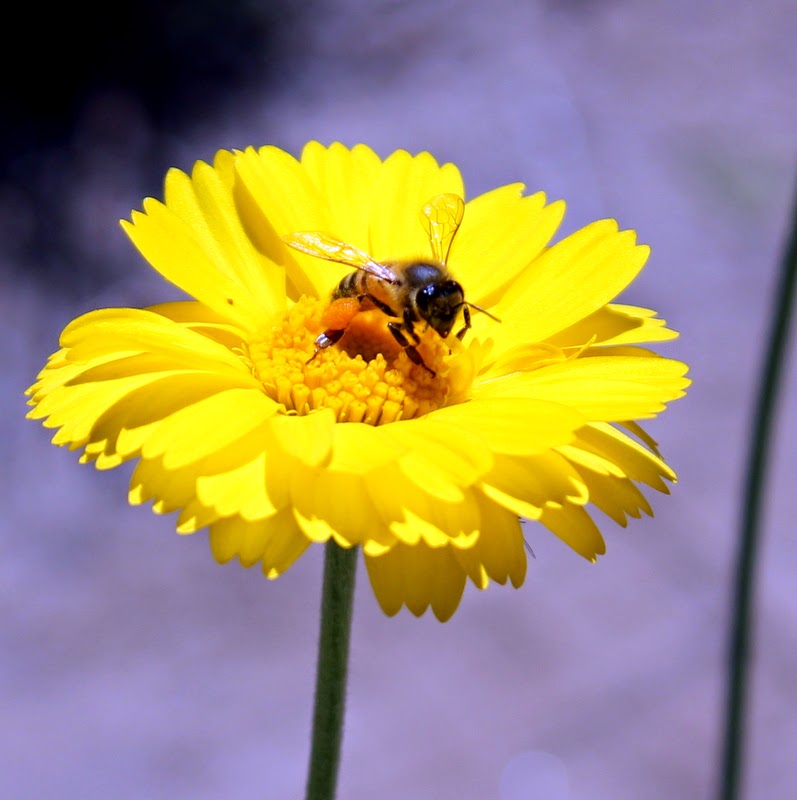
a bee, quite intent on loading up his pollen baskets.
They really don't pay any attention to me at all as I'm taking pictures;
they're too focused on the task at hand (so to speak, lol).

Sorry this post got sort of long; I started out with random photos then went down a bit of a rabbit hole, looking up the history of the Arboretum. I hope it was interesting, though- it was really interesting to research!

This blog post was made possible with information from the Arboretum's History Page, (here), the William Boyce Thompson page from the Yonkers Historical Society website (here), and the Wikipedia entry for the Arboretum (here) as well as various other websites including the AZ National Parks page.