Showing posts with label boyce thompson. Show all posts

May 20, 2014

more random pics from the Arboretum, March 2014 (and some history)

William Boyce Thompson was an American mining engineer and financier who lived from 1869 - 1930. He was born in Montana during a time when Montana was experiencing a mining boom and was sent to the East Coast for schooling as a teenager, but didn't enjoy school at all-- he left the Exeter Academy without graduating. He enrolled in the Engineering program at Columbia (apparently back then you didn't need a diploma to enroll, lol!), but left after his freshman year. He returned to Montana and got married in 1895, then moved to New York City in 1899 to start invest in mining stocks. By 1906, he was a self-made millionaire. In 1907, he purchased the Magma (Copper) Mine in Superior, AZ, and had built a 67-room Gilded Age estate in Yonkers, NY. (this is kind of sad; apparently his NY estate was abandoned for many years: read the story here.)

another wildflower close-up

In the early years of the 20th century Thompson had much success on Wall Street and was involved in many different endeavors including philanthropy and humanitarian causes, politics, being a political envoy to different countries including Peru and Russia, and working with the Red Cross. After World War I, he decided he disliked politics and devoted more time to the winter home (Picket Post House) he was building in the hills near Superior, AZ. He originally didn't even own any of the land where he was building his winter home; the Forest Service owned it as part of the Crook National Forest. He had to get a special permit from them just to build the house. 

a winter visitor I was really excited to see- a male Hooded Merganser duck.
Not the best photo, but he seemed kind of shy so this was actually pretty good.
(thank goodness for the long camera lens!)

Apparently he used some of his Wall-Street deal-making abilities with the Forest Service, though, and in exchange for him buying and giving them some land they wanted in Northern AZ, they gave him ownership of 400 acres of the National Forest around the house he was building. He chose someone from the University of Arizona to establish the Boyce Thompson Southwest Arboretum on a portion of the 400 acres; its mission was to study the plants of desert countries and make the results available to the public. 

a small lizard, warming himself in the spring sunlight.
He's actually quite colorful, as is the lichen-encrusted rock he's sitting on.


One of his philanthropic endeavors back in NY was also plant research, to study plant physiology with the goal of ensuring a stable food supply for the growing US population. He had developed an interest in plants after his Red Cross visits to Russia during WWI, where he came to understand how important plants are for humans as a source of food, clothing, and shelter. Apparently his original Institute for Plant Research site- which was across the road from his NY estate- is abandoned also; see the story here with more photos. (kind of creepy, actually.) FYI, the Institute is still functioning, and today is housed on the campus of Cornell University.

fruit tree blooms of some sort.
Not sure what kind of tree it is, but the salmon-pink color is gorgeous!

In one part of the arboretum, there is a very old stone cottage that's tucked right up next to a vertical cliff face (the cliff wall actually forms one wall of the cottage). This cottage was lived in years before Colonel Thompson bought the property, and its grounds contain planting beds including an herb garden, roses, and a small orchard area. (unfortunately I don't know my fruit trees either- without the fruit on, lol- and didn't think to look for tags on the trees.)

a view of the Queen Creek from a small suspension bridge that crosses it.
Picket Post House isn't visible in this photo, but it's on top of that ridge,
right above / behind that bright green tree.

The Arboretum is Arizona's oldest and largest (at 323 acres) botanical garden, was the first purely botanical institution in the inter-mountain states, and is the fourth oldest botanical garden west of the Mississippi River. It houses over 600 kinds of cacti as well as rare and endangered plants from around the world totaling more than 2,600 species altogether. It is an Arizona State Park, a National Historic Site, and in conjunction with the University of Arizona, a scientific research facility. It's a very beautiful- and picturesque- place to visit, and well worth the drive. (It's about an hour's drive from Phoenix, and just under two hours from Tucson.)
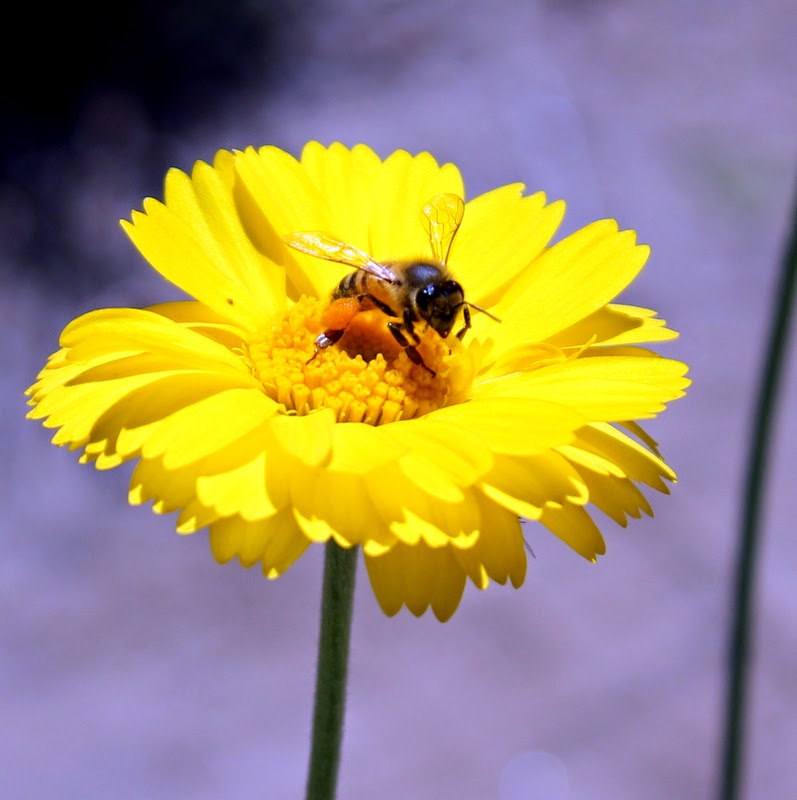
a bee, quite intent on loading up his pollen baskets.
They really don't pay any attention to me at all as I'm taking pictures;
they're too focused on the task at hand (so to speak, lol).

Sorry this post got sort of long; I started out with random photos then went down a bit of a rabbit hole, looking up the history of the Arboretum. I hope it was interesting, though- it was really interesting to research!

This blog post was made possible with information from the Arboretum's History Page, (here), the William Boyce Thompson page from the Yonkers Historical Society website (here), and the Wikipedia entry for the Arboretum (here) as well as various other websites including the AZ National Parks page.

May 18, 2014

it's all about scale... seeing the details

March in Arizona is prime wildflower time... the spring weather, warmer temperatures, and (hopefully) a good amount of winter rain all work together to make the short span of time between winter and the summer heat quite beautiful. Some years more than others, of course (that whole 'rain' thing is important!), and it helps if you know where to look, too. (The state parks department posts updates on their website to let people know when and where to go!) 

When we were hiking at the Boyce Thompson Arboretum in March, along with the gorgeous vistas and beautiful scenery, there were quite a few wildflowers blooming. Here are a few pictures I took along the way (we'd be walking along, I'd see one, and yell ahead to Tom to 'hold up!!' till I took some pictures...) it made for some slow hiking! That's because some flowers are big, bright, and showy, but not all of them; some of them you need to look pretty carefully to see. 

These plants were growing out of a pretty-much-vertical hillside.
(the green arrows are pointing towards one individual clump.)

{a closer view}
This entire clump was, maybe, as big as my blue Pyrex mixing bowl??
(that's about 6 inches in diameter, and maybe, 4 inches high)

{closest}
I'd estimate that this pale purple flower was about as big as my thumbnail.

This plant was growing pretty much right out of the rock.
The clump of greenery was about the same size as the plant above,
but with bright red flowers on multiple flower spikes.
 
{closer}
This isn't the same exact plant, by the way.
That plant was on the edge of the rock overlooking the creek below,
but there were more growing right next to the path we were on.
(close proximity to the path made for much-less-scary picture taking!) 

{closest}
The flowers are quite complex, up close. By the tubular flower shape,
this plant is probably pollinated by butterflies or hummingbirds.
  
I didn't take a picture of this plant in its 'natural habitat' unfortunately.
I don't remember, but there probably wasn't too much interesting about it;
the (very!) tiny yellow flowers caught my eye, though.

{close-up}
This close, you can also see that the foliage is kind of 'hairy'

This view is along one of the paths,
where the tree on the left and the agave bloom to the right make a sort of 'arch' over the path.
(the plant I'm concerned with is the magenta flowers at the very bottom left edge of the picture.)

{closer}
Another low-growing plant with tall flower spikes.
This plant (+ flowers) was maybe, as tall as my knee, or taller??
(I don't remember, exactly.)

{closest}
These are a purplish-magenta color, and shaped a bit different than the red ones.
This one is probably pollinated by butterflies or hummingbirds, too.

I think the plants with the flower spikes are probably some sort of Penstemon, although I'm not sure exactly what kind. I don't know anything about the other ones- unfortunately, I haven't learned too much about Arizona wildflowers yet-- other than the fact that they're pretty!! They're also very ephemeral, too. There's a pretty short window of time when the conditions and temps are right for this sort of plant to do their thing: grow, bloom, and reproduce, so the seeds can wait through the summer till the next wildflower season.

It looks like this website: Sonoran Desert Wildflower Report has some good information about dates, blooms, names, and information about what plants bloomed when. I'll have to check it out myself, before next spring! (and also, maybe to get a macro lens for my camera, in order to get better, very close, close-ups.)